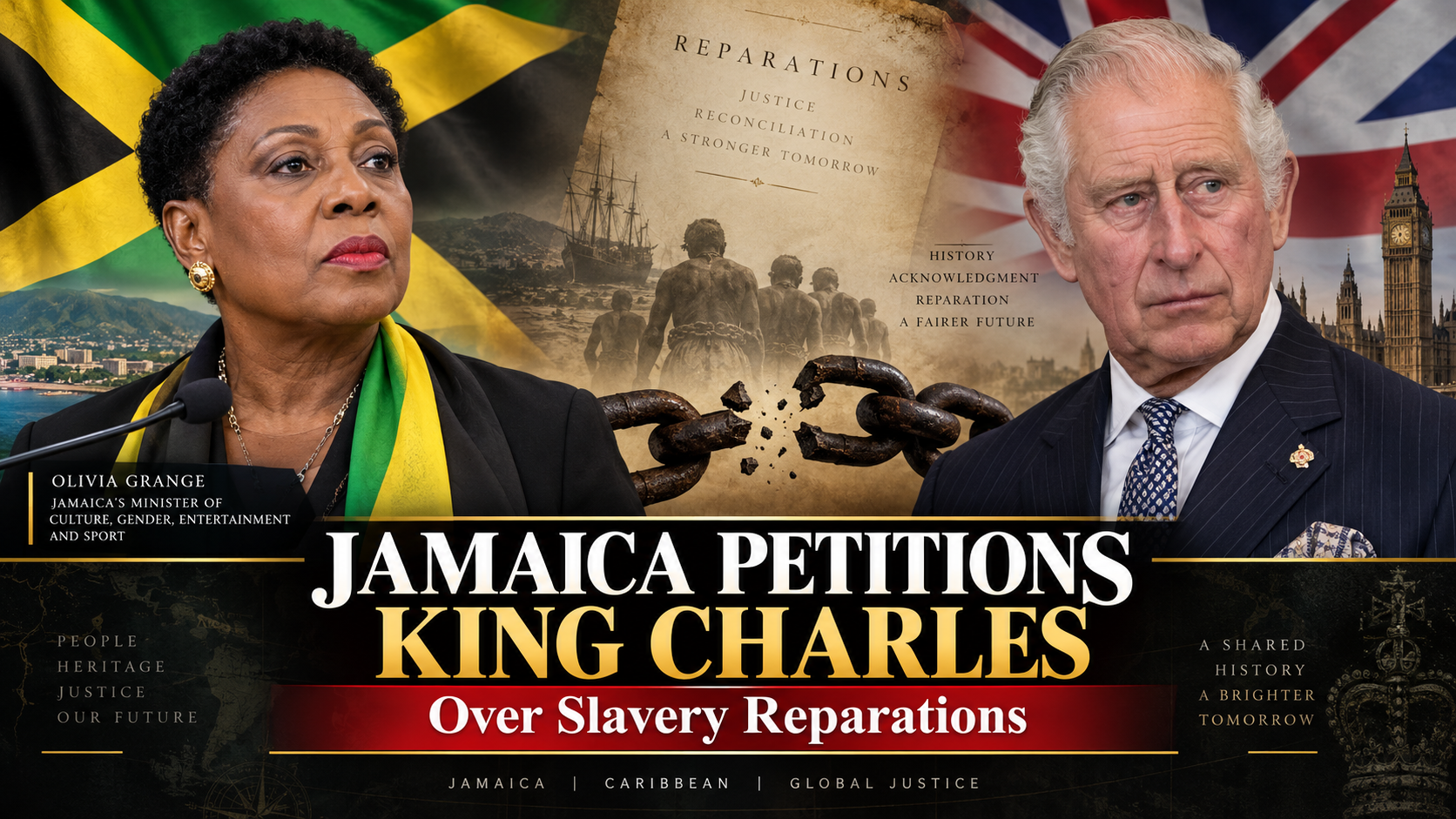
Jamaica is poised to take an unprecedented legal step in its pursuit of reparatory justice. A Government delegation, led by Culture, Gender, Entertainment, and Sport Minister Olivia Grange, is traveling to the United Kingdom to present a petition to King Charles III. Expected to be delivered on Monday, September 7, 2026, the document seeks legal clarity on the enduring legacy of the transatlantic trade in enslaved Africans.
A Legal Shift in the Reparations Campaign
The petition represents a strategic evolution in Jamaica’s approach to reparatory justice. Traditionally, reparations debates have centered primarily on direct financial compensation. However, this new filing places the issue firmly within a formal legal framework. The petition formally asks King Charles III, in his constitutional capacity as Jamaica’s head of state, to refer three legal questions to the Judicial Committee of the Privy Council.
These questions seek to clarify:
- Whether the forced transportation of Africans to Jamaica and their subsequent enslavement were lawful under fundamental principles of common law.
- Whether the forced transportation and enslavement of people of African descent constituted crimes against humanity under international law for which the United Kingdom bears responsibility.
- Whether the United Kingdom is under an obligation to provide a remedy to the Jamaican people for the unlawful transportation and enslavement of Africans in Jamaica under British rule and for the continuing consequences.
Minister Grange emphasized that this strategy marks a new legal phase following years of international advocacy. The delegation includes key representatives from the Office of the Attorney General, the National Council on Reparations, and the Ministry of Culture.
The Zong Massacre and Artifact Repatriation
The visit’s timing aligns directly with the anniversary of the infamous 1781 voyage of the slave ship Zong. During this transatlantic journey from West Africa to Jamaica, at least 132 enslaved Africans were intentionally thrown overboard. The massacre subsequently sparked a landmark legal dispute over an insurance claim, exposing a system that treated human beings merely as lost cargo.
To honor the victims, Minister Grange will participate in a solemn remembrance service and lay a floral tribute in South London on September 6. Concurrently, the delegation will hold strategic discussions with British Museum officials to negotiate the possible repatriation of historical Jamaican artifacts removed during the colonial era.
CARICOM’s Regional Reparatory Justice Agenda
Jamaica’s latest legal maneuver does not occur in isolation. It forms a crucial component of a broader, unified movement spearheaded by the Caribbean Community (CARICOM) and the CARICOM Reparations Commission. Caribbean governments have consistently argued that the systemic effects of centuries of slavery and colonialism continue to severely hinder economic development, public health, education, and social equality across the region.
This development surfaces just as CARICOM prepares for its third regional conference on reparations, scheduled to take place in Barbados later this month. At this pivotal summit, Caribbean leaders and advocates will discuss actionable steps to implement the regional reparatory justice agenda. The development is expected to draw regional and international attention as Jamaica tests whether its reparations campaign can advance from political and moral advocacy into a formal legal process.
Follow the Caribbean Reparations Movement
Stay informed on Jamaica’s historic petition and the wider CARICOM reparations agenda. Follow our ongoing coverage for the latest news, expert analysis, and regional updates on this developing story.